Urban Gardening: Precarity and Instability in Baltimore, Maryland
Intan Kumbayoni<sup>1</sup> and Reilly Becchina<sup>2</sup>
<sup>1</sup>Michigan State University; <sup>2</sup>University of Vermont
The garden was gone.
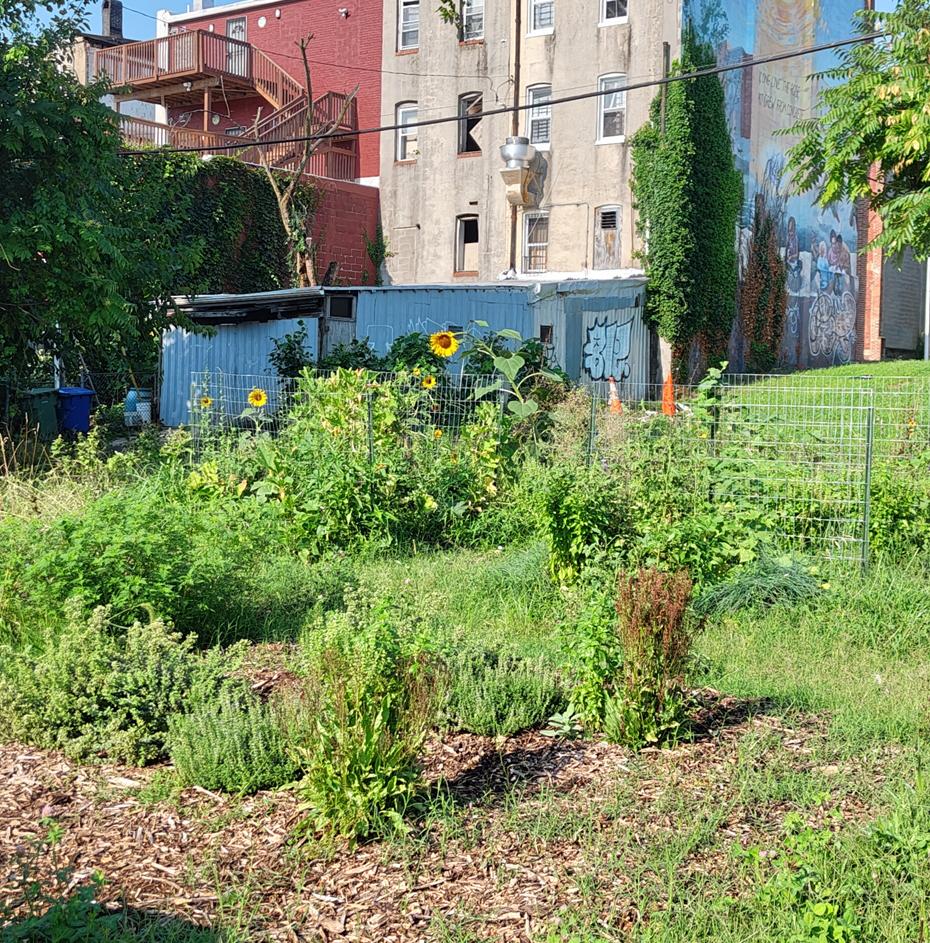
On our first day of fieldwork in May 2024, our supervisor brought us to Baltimore, Maryland. She wanted to introduce us to Ms. Paige, an urban gardener who had been growing food on a vacant lot through the city’s Adopt-a-Lot program. This visit marked the beginning of our master’s project on alternative urban food provisioning networks. When we arrived at the address we had been given, the lot was empty. A neighbor told us that Ms. Paige had moved after the city reclaimed the land where her garden once stood. A few blocks away, we found her in a vacant lot between two houses, working with her neighbors to prepare the ground. The soil had already been turned, but weeds and debris still clung to some parts of the space. We decided to join them, pulling out trash and wild garlic, lifting broken pieces of plastic and glass, and working carefully around patches of poison ivy. As we worked, Ms. Paige thanked us for coming and apologized that the space was still messy. She said she felt bad asking people to help again, but she was eager to start over. Standing there, hands dirty and unsure what to say, we felt confused. We had come to begin a research project. Instead, we were beginning to understand how easily a growing space could disappear, and how often starting again had become part of the work.
Ms. Paige's experience is shaped by the structure of Baltimore’s Adopt-a-Lot program. Administered by the Baltimore City Department of Housing and Community Development, the program allows residents and community groups to steward vacant city-owned lots for uses such as gardening and neighborhood greening. Participants receive a license to use the land, but not ownership, and the city retains the authority to reclaim the lot at any time (Baltimore City Department of Housing and Community Development 2025). This arrangement creates opportunities for community cultivation while simultaneously producing insecurity, as growers invest time, labor, and resources into land they do not control. Legal analyses of the program emphasize that these licenses are inherently temporary and conditional, which leave the gardeners vulnerable to displacement even after years of maintenance and care (Community Law Center 2025). For growers like Ms. Paige, the promise of access is inseparable from the risk of loss.
This form of precarity is not evenly distributed across the city. Baltimore’s geography and food system have been shaped by more than a century of racially discriminatory policies and practices. In 1910, the city passed one of the first racial segregation ordinances in the United States, legally restricting where Black and White residents could live and laying the groundwork for deeply uneven neighborhood development (Power 1983). In the decades that followed, federal and local housing policies, including redlining through the Home Owners’ Loan Corporation in the 1930s, further entrenched segregation by systematically denying mortgage credit and investment to majority-Black neighborhoods (John Hopkins Sheridan Libraries 2017). These practices confined Black households to disinvested areas in East and West Baltimore, creating the phenomenon of the “Black Butterfly” which is still visible today. Black neighborhoods fan out like the wings of a butterfly to the east and west of the “white L,” made up of predominantly white neighborhoods aligned with the north-south corridors that extend down into the Inner Harbor (Brown 2021). Over time, these patterns of residential segregation and disinvestment have shaped who has access to healthy, affordable food. Legacies of redlining and segregation continue to shape contemporary food environments, and it leaves many historically disinvested neighborhoods with fewer supermarkets, limited access to healthy food, and higher rates of food insecurity and diet-related illness (Y. Shaker et al. 2022).
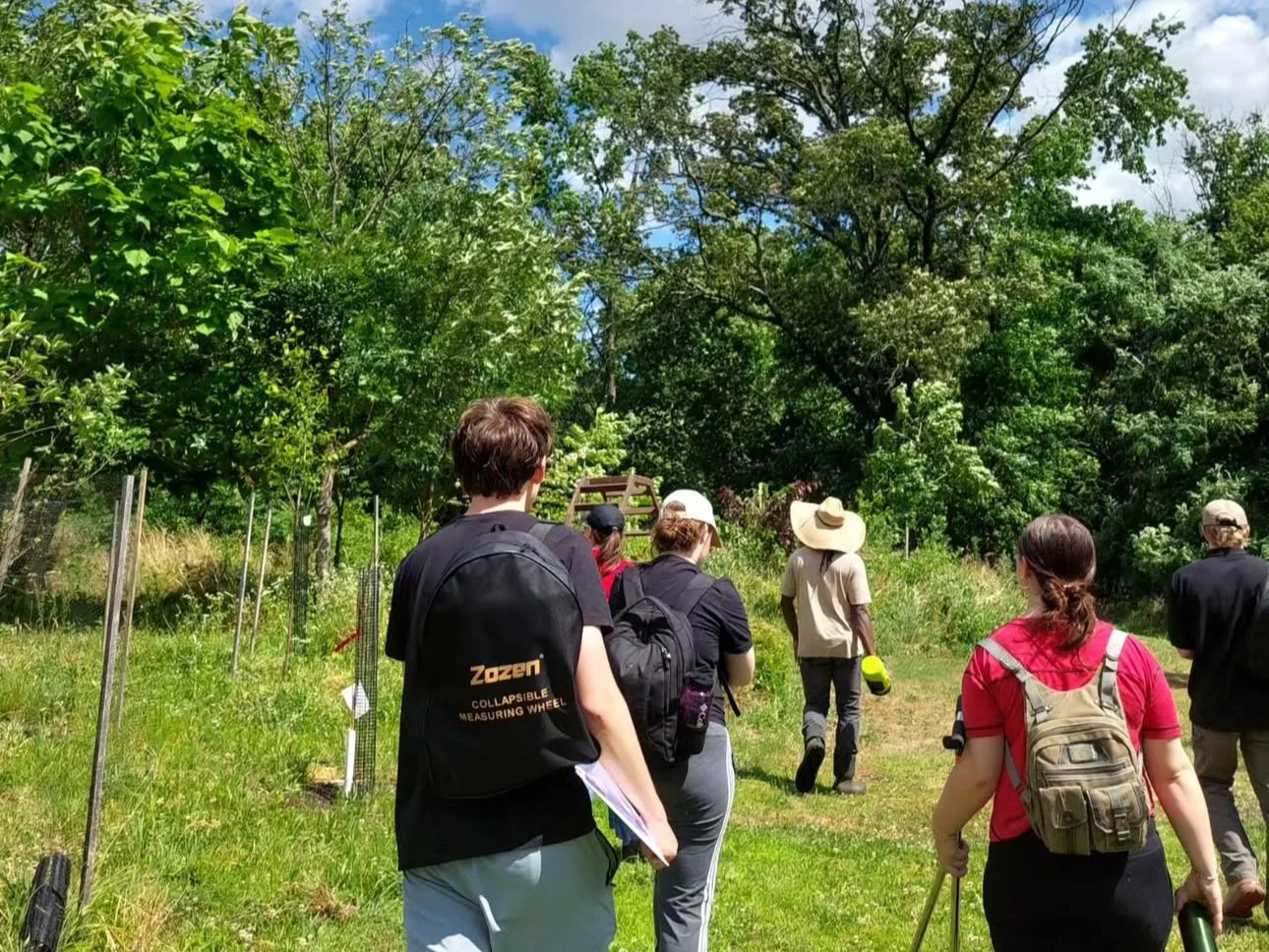
Against this backdrop of racialized food insecurity and unstable access to land, many residents in Baltimore turn to urban agriculture as a way to meet needs that the commercial food system does not. These commitments take shape in concrete ways across Baltimore. One of the examples is an urban farming initiative we visited during fieldwork with a group of undergraduate interns. On the day we visited, we spoke with John, one of the growers, as he walked us through the site and described the work they do. The garden was filled with a wide range of vegetables and foods selected to reflect the cultural preferences of the predominantly Black neighborhood. John explained that their mission is to reconnect Black, Indigenous, and people of color to local food, land, and nature in a city where access to green space and culturally meaningful food has long been uneven. Gardening is only one part of their work. The site also supports youth nature camps, volunteer events, urban farming education, community social gatherings, and professional development activities. Much of this work is oriented toward residents and schools in Northeast Baltimore, as well as others seeking access to green space. Rather than responding to food insecurity through standardized aid or market-based solutions, this farming initiative emphasizes community presence, education, and long-term relationships with land as central to food access and well-being.
Other forms of urban agriculture in Baltimore unfold through more intimate networks of care. Jane, a member of a local church, became a key person who introduced us to the Burmese refugee community in the city. Many of the refugees she works with face language barriers that make navigating grocery stores, food assistance programs, and other institutions difficult. As Jane explained, “everything becomes harder” when people arrive as refugees without English language skills, especially when trying to find familiar and appropriate food. Several community members missed the foods of their homeland and lacked space to grow them. In response, Jane helped initiate a community garden on unused church land, working alongside Burmese church members to build and maintain the space. When we visited, we observed a range of plants commonly used in Southeast Asian cuisines. While participation in the garden is primarily among church members, the harvest circulates more widely. Produce is shared with the broader Burmese community and placed in the church food pantry. Through Jane, we also visited home gardens tended by Burmese refugees with access to small yards. These practices offer more than food because people are rebuilding their lives far from home.
Care and cultivation also took shape through teaching and personal recovery. We met Michael while visiting a garden run by a local non-profit, where he was working with two young men. He showed us how they made compost, collected rainwater for irrigation, and learned by taking responsibility for the land together. He spoke with pride about teaching practical skills through gardening and described the space as one where learning happened through doing. Later, Michael invited us to visit his home garden. Unlike the community site, it was filled with flowers rather than food crops. There, he shared why gardening mattered to him personally. After his daughter passed away, he told us, he struggled to cope. Working in the garden helped him process his grief and gave him something steady to return to each day. “I was drowning for a while,” he said, “and the garden helped me come back.” Through Michael, we learned that urban agriculture could offer stability and purpose beyond food provisioning alone.
Not every garden, however, is given the time or security to endure. Sean was one of the gardeners who reached out to participate in our research. When we visited his garden, he showed us the irrigation system he had built and the fresh mulch he planned to spread across the beds. Born and raised in Baltimore and currently unemployed, Sean used the garden to feed himself and share food with friends and family. He spoke with pride about the care he had invested in the space. A few months later, Sean contacted us again. “The city mowed my lot,” he said. The garden was gone, despite the time, money, and effort he had put into transforming the abandoned space. After that, he said, he no longer wanted to garden.
Across Baltimore, the violence of the food and farm system rarely appears as a single dramatic act. Instead, it unfolds slowly through policies and practices that render land temporary, labor disposable, and care easily erased. The mowing of Sean’s garden, the displacement of Ms. Paige’s growing space, and the constant uncertainty faced by growers reflect a broader structure in which the state governs food access through instability, granting permission to grow while retaining the power to revoke it at any moment. For the people we met, growing food was closely tied to everyday life. Gardening supported health and made it possible to maintain food practices that are culturally meaningful. Structural violence intervenes precisely at this point.
The garden was gone when we arrived in May. By the end of our fieldwork, it was clear that its disappearance was not an exception, but a pattern. What remains uncertain is not whether people are willing to grow, teach, and care, but how long they can be asked to do so when the ground beneath them is never secure.
*All names have been changed to preserve anonymity.
Works Cited
Baltimore City Department of Housing and Community Development. Adopt-A-Lot Program. Accessed December 11, 2025. https://dhcd.baltimorecity.gov/nd/adopt-lot-program.
Brown, Lawrence T. The Black Butterfly: The Harmful Politics of Race and Space in America. Baltimore: Johns Hopkins University Press, 2021.
Community Law Center. Adopt-A-Lot License Agreements. Accessed December 11, 2025. https://communitylaw.org/urbanagriculturelawproject/urbanagriculturelawprojectadopt-a-lot-agreements/.
Johns Hopkins Sheridan Libraries. The Baltimore “Redlining” Map: Ranking Neighborhoods. Accessed December 11, 2025. https://blogs.library.jhu.edu/2017/09/the-baltimore-redlining-map-ranking-neighborhoods/.
Power, Garrett. “Apartheid Baltimore Style: The Residential Segregation Ordinances of 1910–1913.” Maryland Law Review 42 (1983): 289–328.
Shaker, Y., et al. “Redlining, Racism, and Food Access in U.S. Urban Cores.” Public Library of Science / PMC, 2022.