
The Rise of a Gendered and Generational Labor Regime in Rural China
Miaomiao Qi
Cornell
In July 2025, a bus of fourteen farmworkers, mostly mid-aged and elderly women, was carried away by flood waters on the way to pick chili peppers in greenhouses. A year before in June 2024, eight women workers, most in their fifties, suffocated to death in a refrigerated truck on their commute to home. They worked for a beef processing plant fourteen kilometers away from their villages, and the refrigerated truck was mainly used for transporting beef but also served as their daily commuting vehicle. The two tragedies are among many incidents reported in the news that spotlight the precarious and dangerous conditions under which rural women often work. They also reflect a trend in rural China: rural women in their fifties, sixties, or even seventies are increasingly on the move for paid agricultural work. Described as the so called ‘left-behind’ women, they used to stay behind to take care of children and land while other family members migrate for urban jobs.
In 2024, I conducted an ethnographic field project with a group of Yi women in an ethnic Yi-dominated region in Yunnan province of southwestern China. In my research, I observe that these ethnic Yi women who have joined seasonal migration to work in cucumber greenhouses in the 2010s, are all on a financial treadmill to satisfy the social reproductive needs of their households and community. In this frontier region, with a favorable climate and cheap land, the local state plans to develop and modernize its vegetable industry to absorb rural labor and alleviate rural poverty (termed chanye fupin, or “poverty alleviation through industry development”). With the institutional and fiscal support from the state, large numbers of both big and small investors have flooded into the area, transforming local smallholder farming into capital-intensive controlled-environment vegetable farming. The land rush has opened up new sites of rural accumulation, with the ‘left-behind’ women and elderly serving as cheap labor powering the expanding industry. Complicating the state picture of poverty alleviation, I emphasize that rural women and elderly people are forced to agriculture wage labor due to the increasing cash demands for family reproduction.
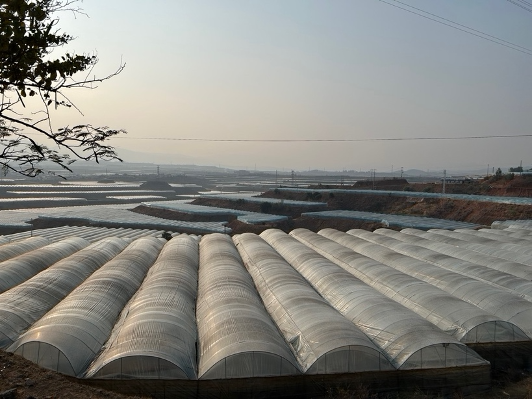
Cucumber greenhouses are quickly expanding in this ethnic-Yi dominated frontier region.
Organized through family and extended kin ties, smallholders of ethnic Yi, Lisu, and Miao from surrounding mountainous areas migrate to work in the rapidly expanding cucumber greenhouses in the hot valley during the growing cycle from September to April. Each day, they work for ten to twelve hours, often in dangerously hot environments to reorient cucumber vines, tend pathogen-infested plants, or harvest cucumbers. During my fieldwork, I heard of instances of farmworker deaths related to heat stroke and many instances of work-related injuries. In the region, the low-pay, arduous, and ‘unskilled’ work in greenhouses is commonly seen as ‘women’s work,’ disregarded by the young and the male workers who tend to seek higher paid jobs in urban areas. Nevertheless, these women’s ‘quick hands’ and ‘docility’ satisfy the capitalist farmers’ need for a controllable and efficient labor force. To the local state, the dangerous work environments and low pay are not a major concern. Rather, the greenhouse expansion is promoted as a model of development that provides flexible and informal job opportunities that allow rural women to earn additional income while still satisfying their care-taking roles.
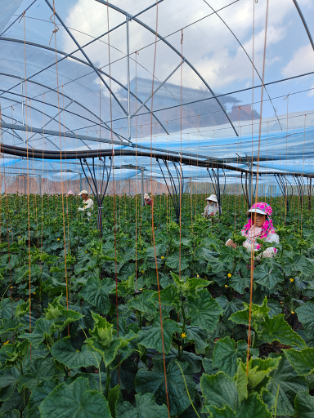
Yi workers stand in different lines to tend
cucumber plants.
A labor regime built upon gendered and generational exploitation has thus arisen in this frontier region. To the state and capitalist farmers, the unequal treatment of the ‘left-behind’ women and elderly on the local job market are justified by their reproductive roles in the domestic sphere. However, as feminist scholars have shown, this justification precisely highlights how the agrarian labor regime is embedded in the reproductive sphere, and these Yi women’s suffering in the work regime has its root in their position as unpaid laborers in their home and community.
In my interviews, Yi farmworkers must frequently travel back home to take care of family members or anything that comes up in the village, including ceremonies such as newborn birthdays, weddings, funerals, housewarming parties, and more. During the Lunar New Year in 2024, I visited the Yi villages where these farmworkers are from. The cucumber farm bosses were offering more than double wage than normal days, yet all my interlocutors were busy with helping their relatives carry out events, cook, clean, and greet guests. Although the pay was enticing, the toll of missing and not contributing labor to these events would be high, as family and kinship ties have again become essential for providing a safety net for rural members following the state’s retreat from welfare. Especially when their husbands or children work in urban areas, mid-aged and elderly women have to represent their families to attend the events and contribute labor and gift money so that social connections can be maintained. In this way, their position as unpaid laborers that sustain the biological and social life of the Yi community members contributes to their struggles in the wage labor force.
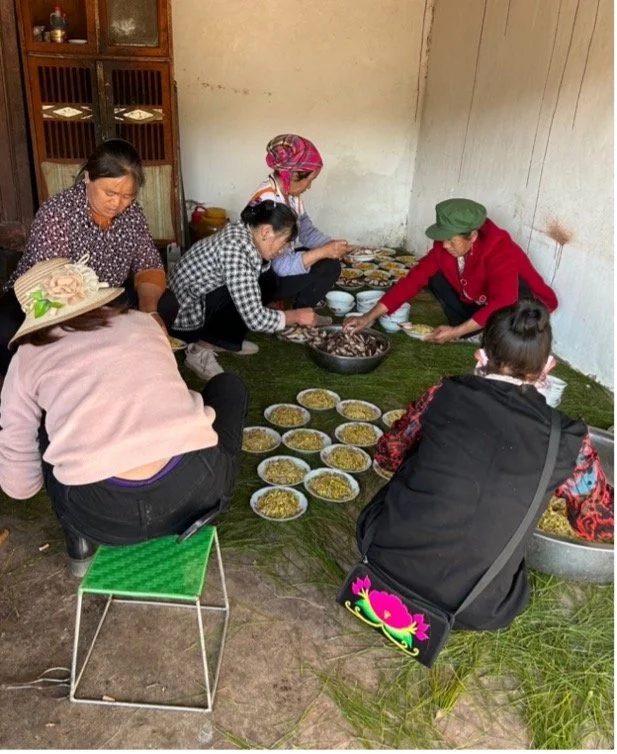
Yi women help prepare food for a wedding during the
lunar new year.
The interlinkages of productive and reproductive dynamics in rural women’s everyday life and work have thus shown the importance of revealing the often-concealed process of life-making behind agrarian transitions. Doing ethnographic research both in these farmworkers’ workplaces and at home villages, I highlight that the emergence of a gendered and generational labor regime in the region is not only the result of a capitalist agrarian transition, but also a result of the changing conditions and aspirations of rural social reproduction. Among the Yi farmworkers I followed, none of them are considered to be living in poverty by the state standard. Most of the families have built new rural houses and own cars or other vehicles, and some families have their own business with relatively good incomes. However, these women maximize all possible time to do paid work and are in constant distress to make more money. In one incident, a motorized three-wheeled vehicle carrying many Yi women toppled over on a steep dirt road on their way to harvest cucumbers. They all fell off and some rolled down to the deep trench on the roadside. Some women were severely injured and had to be taken to hospital. The rest of the workers who had minor injuries did not stop working, continuing to harvest cucumbers like nothing happened.
For these ‘left-behind’ Yi women, the urgency of working non-stop and making as much money as possible, even it often means subjecting themselves to arduous work in harsh or dangerous environments, comes from the intensifying squeeze in the reproductive sphere. As marketization deepens, the Chinese state is increasingly retreating from its welfare provisions, including healthcare, education, and housing, and this has turned these basic reproductive needs into consumption items based on market supplies. The declining state welfare in rural China reinforces new aspirations of rural families and communities, impacted by rising consumerism and materialism since the 1990s. Rural families aspire for a modern urban life through buying urban flats and cars and for upward mobility through investing in their children’s education. Failing to do so would been seen as a family’s inability to pursue a decent and happy life. As such, the commodification of social reproduction has turned rural life-making into a struggle for maintaining social status through competitive consumption, creating social and financial pressures for rural residents.
New expectations and standards for how reproductive activities should be conducted have also emerged in China’s rural communities. To improve their children’s opportunities and maintain family social status, the mid-aged and elderly have to step in to bridge the gap of reproductive needs. For the Yi families, this means pressure to make more money so they can contribute gift money or host decent ceremonies, send their children to an urban school, afford care at urban hospitals, and help their children (especially sons) secure a marriage. In the case of my interlocutor Hong (pseudonym), a 55-year-old Yi woman who had just started migrating for wage work for the first time in her life, it means to prepare competitive bride price (between $9,000 to $21,000 USD according to local standard), purchase an urban flat (often the groom parents pay initial down payment and the new couple pays monthly mortgage loan), and buy a car, so that her 29-year-old son who does not have a stable job can have a chance of getting married.
Bearing the financial and mental pressures brought by all the reproductive duties, the so-called ‘left behind’ women and elderly, who were assigned to take care of family members and tend the land, become an available labor force for the region’s agrarian transition. However, their backbreaking and non-stop wage work is merely a struggle to keep up with the existing level of social practices. The wage work they engaged in is offering little hope to meet the costs of reproductive duties while leaving them with a broken body. What gives rise to a new agrarian labor regime that relies on the ‘left-behind’ population is not only the region’s agrarian transition that takes advantage of the gendered and generational labor force. But hidden in plain sight, it is that rural social reproduction has turned into a competition of money-making and consumption, driving the ‘left-behind’ women to take on low-paid work in often dangerous environments.
References
Mezzadri, Alessandra, Sara Stevano, Lyn Ossome, and Hannah Bargawi. 2024. “The Social Reproduction of Agrarian Change: Feminist Political Economy and Rural Transformations in the Global South. An Introduction.” Journal of Agrarian Change 24(3): e12595. doi:10.1111/joac.12595.
Xiang, Biao. 2021. “Reproduction-Driven Labor Migration from China.”
Yan, Yunxiang. "Neo-familism and the state in contemporary China." Urban Anthropology and Studies of Cultural Systems and World Economic Development (2018): 181-224.