Peas in a Pod: Pleasure for Consumers, Profit for the Nation, and Poverty for the Peelers
Karina Beras, PhD
Stony Brook University
Pigeon peas are in abundance throughout Batey Libertad, a small sugarcane settlement community, colloquially referred to as “the batey[1].” The legume forms part of the local economy as peeling it is a source of labor for a majority of the batey residents, one such resident being Francisca. On a late afternoon in July of 2021, once the sun began its descent and no longer scorched the skin, Francisca sat outside of her home in Batey Libertad with two large basins in front of her and a sack of pigeon peas beside her. All were filled with pigeon peas – some still in pods, others due for peeling, and another subset already peeled. The peeled peas stood out in their bright green color and smell of fresh earth and rain. Without context, an image of a basin filled with peas evokes a romantic and yearned-for country-side lifestyle that urban dwellers and diasporan Dominicans imagine as simplistic and fulfilling. In Batey Libertad, however, the pigeon pea does not produce similar nostalgia. The peas are a means to an end.
Over the years, peeling pigeon peas has become a leading source of employment for residents of Batey Libertad, a community that forty to fifty years ago was dependent on sugarcane harvesting. Now, a fragment of the population—mostly younger, able-bodied men with temporary or seasonal work permits—labors in the rice fields and the accompanying mill across the highway from the batey.
Importantly, the nature of pigeon pea processing allows residents to work for pay while staying within the confines of the batey, which is especially important since many identify as residing in the country under an irregular legal status.[2] In a state where anti-Haitianism and the active persecution of Haitian descendent people is a cause for fear and concern, staying in place can be life-saving. Specifically, anti-Haitianism explains the devaluation of labor, policing of movement, and spatial segregation that people of Haitian descent experience under a hostile national climate (Simmons 2010).
Pigeon pea peeling, beyond its utility as a source of employment, provides an aperture into larger systems at work such as social control, the labor economy, and racial stratification in the Dominican Republic. The emplacement of pigeon pea peeling within the borders of the batey makes the batey both a safe haven and a carceral space. In addition to the nature of the work, the low pay also forms part of carceral logics of exploitation that approximate that of slavery, as became evident in my conversations with batey residents. The duality produced by pigeon pea laboring reminds me of Sadiya Hartman’s assertion that the “…endeavor to live free unfolds in the confines of the carceral landscape…[they] still want to get ready for freedom” (2019, 24).
Returning to my ethnographic encounter with Francisca, I recall how she repositioned herself on a small wooden stool as I approached her. We had exchanged pleasantries several times before but that day I intended on engaging in a sustained conversation. I wanted to learn more about her experience living in the batey and her process for acquiring the pigeon peas. Francisca gave a faint smile when I asked about her time in the batey and told me that she arrived at Batey Libertad in the early 1990s. Then in her late fifties and with an expired visa, Francisca considered the batey her haven. She noted that immigration agents and police officers did not enter the batey which gave her a peace of mind coupled with the fact that she could earn a bit of money peeling peas without having to leave her front porch.
While peeling pigeon peas is Francisca’s primary way to make a living, the renumeration is nowhere near equivalent to that of a living wage since the earnings are insufficient for sustaining and meeting the needs of a family household. Speaking to the labor economy and levels of exploitation that form part of it, other batey residents noted that the pay for pigeon pea processing was five hundred and fifty Dominican pesos, the equivalent of ten U.S. dollars, per week. The pay rate provided is based on full loads each week and honest post-production weight readings from the distributor, which was often a source of conflict and mistrust between pigeon pea peelers and the distributors that counted on their labor. That same year, the Central Bank of the Dominican Republic estimated that the average cost of a family food basket for the northern region of the country equaled RD$36,450 pesos per month (Banco Central de la República Dominicana 2025). At an average monthly wage of RD$2,200 pesos pigeon pea peelers hardly earn enough to afford a complete meal.
The discrepancy between the earnings afforded by pigeon pea processing and the cost of a family food basket is a clear sign of the labor exploitation experienced by peelers in Batey Libertad. The low wages paid to Haitian laborers directly translates to affordable food products prices for Dominicans on the island, visitors and tourists, and consumers abroad (Meyer 2009). The imbalance of access and renumeration is a matter of systemic and structural violence. The work of hundreds of batey dwellers helps to feed distant consumers, yet they themselves do not earn enough to cover the cost of food to feed themselves and their families. A tourist can enjoy unlimited pigeon pea stew from the all-you-can-eat buffet at an all-inclusive resort in Puerto Plata or Punta Cana, and diasporan Caribbeans in New York City can grab a can of pigeon peas from the grocery store shelves with relative ease. Meanwhile, the Haitian laborer who helps to harvest and process the peas in the Dominican countryside experiences malnutrition and points of near starvation. What do we make of this kind of cruelty? That the Dominican Republic is a top producer of pigeon peas in the Caribbean makes the unequal dynamic even more troubling.
As if the low pay and place-based nature of pigeon pea peeling were not limiting enough, the sense of safety that Francisca alluded to in 2021 shattered only a year later. In 2022, at least four immigration raids took place in Batey Libertad, leaving community members in a state of heightened anxiety and insecurity. Increasingly, the Dominican state and its non-appointed vigilantes violate the private space of the home in immigration raids and roundups. The semblance of safety that staying in place afforded is fast eroding as the Dominican government ramps up their efforts in the ongoing persecution of people of Haitian decent (Pérez and Robles 2024; Presidencia de la República Dominicana 2022). As evidenced by the occurrences of 2022, the batey is certainly not immune to the violence and disruption of immigration raids. During the raids, some people are spared from removal when acquiescing to the demands of bribery. Five hundred or one-thousand Dominican pesos can save someone from detention during any given interaction with a state agent. This, however, presumes that a person has sufficient funds to pay off a state agent at each encounter. For this community, the possibility of paying a bribe is often impossible. Still, work that allows residents to stay within the batey offers an inkling of security and the added comfort of being surrounded by community members, family and friends.
In addition to the substandard pay and the ever-present threat of deportation and other forms of violence, Batey Libertad residents live under the shadow of shame and humiliation stemming from anti-Haitianism, anti-Blackness, and stereotypes associated with agricultural work an area in which Haitian migrants and their descendants are overly represented. Haitian migrant and intergenerational Dominicans of Haitian descent labor in sugar cane, rice, and banana fields across the island. Due to the nature of their work, laborers live in nearby communities, most of which are still standing bateyes, and others are remnants of bateyes that have blended into the landscape of developing towns and cities. Though agricultural laborers play a significant role in the local, national, and global economy, they occupy a space of physical and social marginality based on their race, ethnicity, and poverty (Schmidt 2009). Moreover, their place of residence adds to their invisibilization. In the Dominican context specifically, the batey evokes the imagery of a colonial sugar plantation and slavery, therefore, associating the term and the physical landscape of the batey with social and ethnic differences (Kieslinger et al. 2024). The imaginary of the batey thus materializes into present-day social stratification in Dominican society. While Haitian laborers in the Dominican Republic are deemed as “…good for labor and no more, worth consideration only to make sure they do not leave the bateyes and spread their dirty diseases, their inferior culture, their black, black skin” (Wucker 1999,113), it is their hands that help feed an island.
During a visit to Santo Domingo, the capital city, I was witness to anti-Haitian rhetoric when a man interrupted his wife—who sat across from him sucking on a stick of sugarcane—to ask, “Did you buy the sugarcane from a Haitian? Watch when something happens to you for going around buying cane from a Haitian!” Echoing the man’s implicitly racist statement, a friend chimed in and said, “It’s true, you have to be careful because the Haitians shit in the bushes and then they come and sell you the cane with their hand full of shit.” While the commentary shared here positions Haitians as unsanitary and distrustful, Francisca sits in Batey Libertad, far away from the capital city, peeling pigeon peas that Dominican city dwellers will eventually consume. As the night falls, Francisca continues working, often resigning herself to another day when she and her two young children may “end up eating dirt for dinner.”

Figure 1: Photograph of a woman at work peeling pigeon peas, taken in March 2023 in Batey Libertad
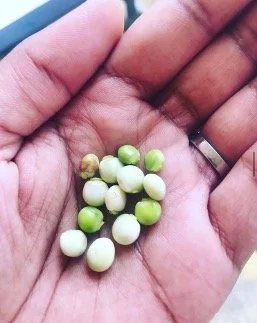
Figure 1: The author holding deshelled pigeon peas after an afternoon of peeling beside an elder in the Batey Libertad community in December 2022
[1] There are over four-hundred bateyes (plural for batey) across the Dominican Republic. Bateyes are historically state-designated settlements meant to house migrant laborers from Haiti and other parts of the Caribbean, particularly during the height of sugarcane production in the 20th century.
[2] I use the term irregular as a more capacious definition to encompass the myriad forms of documentation status and assignations of residents of the batey.
Works Cited
Banco Central de la República Dominicana. 2025. Costo de Canastas de Consumo 2020-2025. Santo Domingo, RD: Banco Central de la República Dominicana. https://www.bancentral.gov.do/a/d/2534-precios.
Hartman, Saidiya V. 2019. Wayward Lives, Beautiful Experiments: Intimate Histories of Social Upheaval. New York, NY: W.W. Norton & Company.
Kieslinger, Julia, Raphael Dohardt, Silke Jansen, and Stefan Kordel. 2024. “What Is a Batey? Origins and Trajectories of an Antillean Concept.” Journal of Latin American Geography 23 (2): 64–90.
Meyer, Carrie A. 2020. “Local Food, Agriculture, and Tourism in the Dominican Republic.” Preprint, Fairfax, VA: GMU Working Paper in Economics, June 19. https://papers.ssrn.com/abstract=3630734.
Pérez, Hogla Enecia, and Frances Robles. 2024. “Los Haitianos Que Huyeron a República Dominicana Con Desesperación Son Devueltos En Jaulas.” En Español. The New York Times, December 9. https://www.nytimes.com/es/2024/12/09/espanol/mundo/haiti-republica-dominicana-deportaciones-jaulas.html.
Presidencia de la República Dominicana. 2022. “Presidente Abinader Emite Decreto 668-22; Dispone Medidas Para Prevenir y Perseguir Invasiones y Ocupaciones Irregulares de La Propiedad Privada y El Estado | Presidencia de La República Dominicana.” November 12. https://presidencia.gob.do/noticias/presidente-abinader-emite-decreto-668-22-dispone-medidas-para-prevenir-y-perseguir.
Schmidt, Ella. 2009. The Dream Fields of Florida: Mexican Farmworkers and the Myth of Belonging. Lanham, MD: Lexington Books.
Simmons, David. 2010. “Structural Violence as Social Practice: Haitian Agricultural Workers, Anti-Haitianism, and Health in the Dominican Republic.” Human Organization 80 (3): 248–55. https://doi.org/10.17730/1938-3525-80.3.246.
Wucker, Michele. 1999. Why the Cocks Fight: Dominicans, Haitians, and the Struggle for Hispaniola. New York, NY: Hill and Wang.