The Spectre of Absentee Landlordism in Prince Edward Island Land Politics
Heidi Haering
Memorial University of Newfoundland and Labrador, St. John’s, Newfoundland, Canada
As I drove up the farm road, I saw two immaculate-looking barns, both gray, trimmed with red, surrounded by green fields. The scene would not be out of place in a photo depicting idyllic rural life. The owner, a retired farmer, was a founding member and representative of the Prince Edward Island chapter of the National Farmers Union (PEI NFU)[1]. “Keep your shoes on and come in!” They ushered me to the kitchen and pointed at a printed copy of The Charlottetown Guardian on the table:
“Have you seen the paper today?”
This was a common question when I sat down to talk with members of the PEI NFU. The newspaper was often on the table of their farmhouse kitchens. Press coverage related to the Prince Edward Island Lands Protection Act[2] (LPA) and the Irving[3] family had been in the paper regularly before my fieldwork began.
Since 1982, land acquisitions on Prince Edward Island (PEI) have been regulated by the LPA. The Act was established, in part, as a reaction to large land acquisitions by the Irving family. They were new arrivals to the province’s agricultural scene in 1980 after acquiring a potato processing plant (McCallum 2008; Phelan 1996; Yaffe 1980). My fieldwork took place in the aftermath of the latest controversial sale, which resulted in the Irving family’s divestment from a global lease agreement (Neatby 2022). Land is a frequent topic of conversation in PEI, and my PEI NFU research participants would often point to farms in the distance and estimate the amount of land certain farmers owned. This interest in land ownership was due in part to the over 100 years in which land in PEI was owned by British grantees, leaving residents as tenants (Bitterman 2004). Also, land was of specific interest to the PEI NFU due their role in shaping the LPA to deal with corporate land ownership (McCallum 2008).
PEI is the smallest[4] and one of the most rural provinces in Canada[5]. It is also a largely agricultural province with 42% of its land devoted to agriculture, additionally, 88% of the Islands land is privately owned[6] (Government of PEI 2024; 2019). My participants, members of the PEI NFU, warned the public of violations to provincial land limits through locally published articles, and had brought to light the latest land purchase by the Irvings. At a time when non-resident land ownership in PEI had actually decreased and corporate land ownership by Island resident shareholders had increased (Neatby 2019), they sought to remind Islanders that the “spirit and intent” of the LPA was to avoid a return to the time of “absentee landlords.”
“Absentee landlordism” was responsible for what is known as the PEI “land question” (McCallum 1999; Bitterman 2004; Hatvany 1997). From 1767 until the late 1875, PEI remained fixed in the proprietorial system under the ownership of the British Crown. The Crown then awarded the 67 lots to British proprietors[7] via lottery (Figure 1). The system was characterized as a consistent source of conflict between landlords and tenants for those hundred years (Bitterman 2004).
Historical accounts of the landlord-tenant struggle in PEI have been influenced by early accounts of the Island produced by self-interested, middle-class residents (Hatvany 1997). Politician and writer John Stewart, for example, published a hugely influential account of PEI in 1806 that framed the landscape through the lens of the “politics of land tenure and the detrimental impact negligent proprietors had on tenants and on the Island’s development” (Hatvany 1997, 111). Stewart had been elected to the House of Assembly on his assurance that “absentee landlord” estates would be redistributed to tenants; however, in reality he had hoped to lower land values enough to allow himself and other middle-class officials the opportunity to buy large estates (Hatvany 1997, 112). In addition, politicians would focus resident anxiety and attention on the “absentee landlords” to distract from socio-economic issues such as crop failures and declines in the shipbuilding and timber industries (McCallum 1999).
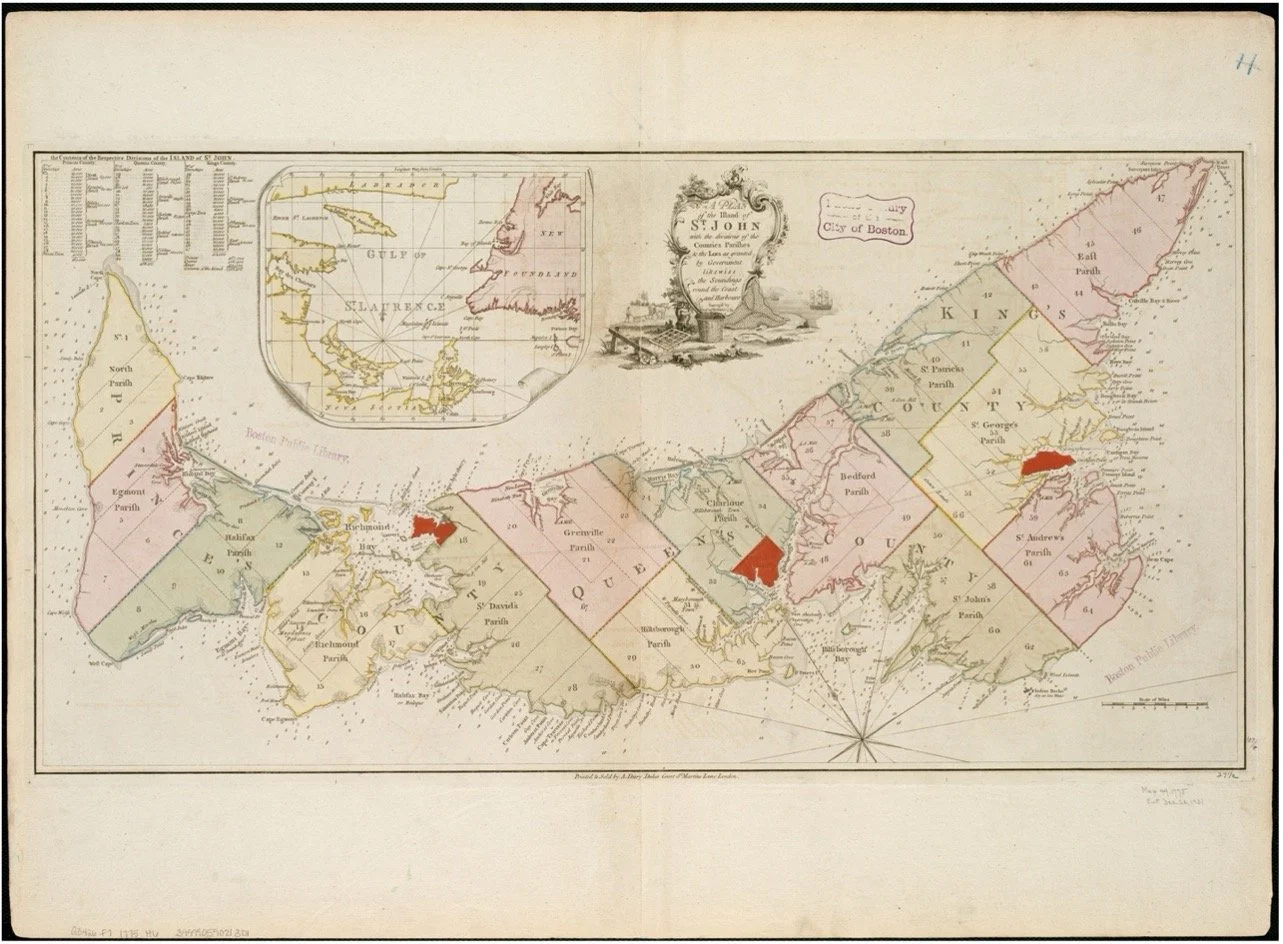
Figure 1 Prince Edward Island shown divided into 67 lots by surveyor Samuel Holland (Holland)
The narrative was that (pre-confederation PEI) was in its “‘golden-age’ of isolation, self-sufficiency, independence and consensus”( Hatvany 1997, 125) and that its prosperity was hampered only by the proprietary system and “absentee landlords.” This view is so entrenched in the history of land politics, that mention of the time of “absentee landlords” is included in the LPA as one purpose of the act[8]. The PEI NFUs use of this shared “keyword” (Williams 1976) inadvertently altered its meaning, illustrated by their use of the term and concept in their local campaigns.
The PEI government needs to be on top of this: we don’t want to return to the conditions of absentee landlord days (Campbell 2017a).
PEI NFU District Director, Douglas Campbell warned that land acquisitions made by those seeking a return on investment were not Island residents. A month later, he flagged an influx of seemingly mysterious “Dutch, Chinese and Taiwanese money” and stated that it would be difficult to “get back the land”:
(Like) in most parts of the world, PEI is experiencing the plague of “land
grabbing.” The lesson learned is that capitalists worldwide view land as a solid
investment, promising future growth in their investment capital. Land is bought
up everywhere for the expectation of an incredible increase in value over the
years.
At the heart of all land grabbing is a source of investment capital. If the
government is serious about its role in protecting PEI land, there must be an
investigation of who are the real investors.
Most Islanders know our land history: that for one hundred years, our land was in
the hands of absentee British landlords. Island farmers held a courageous and
painful struggle to get back the land (Campbell 2017b).
In this published letter, Campbell suggested that purchasers of land on PEI were mainly interested in making a profit on the land value. He explained that if Islanders ignored these buyers, it may be impossible to regain control of the farmland. He invoked “absentee landlords” to remind Islanders that it took 100 years to take back the land and that to ignore this would be an afront to the struggle of those “courageous” farmers. Here he suggested that the land on PEI was originally and rightfully meant for those who now resided on PEI with the reference to “getting back the land.” (emphasis mine).
With the momentum of these letters, PEI NFU members were invited to be part of a land issues symposium panel. Campbell spoke and described the historic land lottery then depicted the “enslavement” of tenant farmers under “absentee landlords”:
Settlers were enslaved as land tenants; they had no control over their land and futures. They suffered economic stagnation, financial and personal hardship, turmoil and unrest. It took great effort and political will to break free of those absentee landowners and for Islanders to hold title to their land (Cooper Institute 2018).
Three years later, I spoke to a new PEI NFU member. They understood the significance and weight of the keyword, but also stressed that it misdirected the issue:
I can understand why it is good press: because it is rooted in island history and there is this kind of – I wouldn’t say a consensus, but there’s a very widespread popular understanding on the island that: “We wrestled the island out of the hands of absentee proprietors and it’s ours now and we need to keep it that way.”
….
So, it’s useful because you’re tapping into existing public understanding of history and existing public sentiment against absentee ownership, but the problem isn’t absentee ownership.
While their perspectives differ, both comments above suggest that the current focus on “absentee landlords” is about keeping ownership of farmland to maintain the status quo and safeguard the land that they, and the families before them, made productive through labour. This present-day use signals attempts to maintain the status quo for landowning farmers, instead of a fight for landless tenants.
In reality, the Canadian agricultural industry relies on subsidies and foreign labour (Venkatesh 2019). In this sense, the struggle of those farmworkers who have “no control over their land and futures” better depicts that of precarious labourers, including Temporary Foreign Workers (TFW).
In 2019, the owner of an Island beef plant claimed that the factory safeguarded the way of life of Island farmers: cattle farmers who depended on its services and potato farmers who depended on its manure for their fields. The “mostly brown” workers were facilitating a way of life for farmers in “one of the whitest provinces in Canada” instead of being able to live it (Toughill 2019). They were subject to a “paradoxical [relationship that] divorces the labour aspect from ownership, where the (white) free landowner is the natural embodiment of the ideal citizen but the (migrant) unfree farm labourer, who actually cultivates the land, is shut off from the privileges of citizenship” (Venkatesh 2019).
Although the National NFU promotes farm worker, Indigenous and TFW issues through working groups (NFU 2025), the PEI chapter had yet to formally address these issues. Instead, their focus remained on issues related to the LPA. At a PEI NFU district meeting, a longtime PEI NFU member expressed confusion about the need for the national working groups and had earlier stressed the importance of the narrow focus of the PEI NFU to me:
The NFU seems to focus more on the land; we’ve been criticized about that by some of our members for being a one to two-issue organization. But everything comes back to the land. So, if the land is not being protected how are you going to protect your communities, the people that are in them and have a thriving province.
As recently as August 2022, nine Vietnamese TFWs were given open work permits by the federal government to let them escape abuse on a PEI farm (Yarr 2022). While the PEI NFU focused on the threat of “absentee landlords,” those whose situations are most reminiscent of historic PEI land struggles seem to be left unprotected, invisible and landless. At a time when the PEI NFU flagged the corporate, resident, land purchases of the Irving family and Cavendish Farms, the use of the “absentee landlord” keyword seems to be a redirection of the actual land concerns to evoke a specific historical narrative. However, this call to history changed the meaning of the term to one that suggests the land in the province should be left to those who currently own it.
[1] The NFU is a Canadian direct-membership farmer advocacy group with chapters across Canada. The organization advocates “for a food system based on the principles of food sovereignty” and “against corporate control” of the food system (NFU 2025).
[2] The LPA stipulates land limits of 1000 acres for individuals and 3000 acres for corporations (Government of PEI 2022)
[3] Well known in the province of New Brunswick (Austen 2025), the Irving family’s Cavendish Farms is the biggest private employer in PEI (Cambell 2020).
[4] Small enough that it is often left off the map of Canada (Yarr 2018).
[5] The Statistics Canada definition of ‘rural’ suggests that over half of the Island’s 156 000 residents live in
rural areas (Brinklow, Lévêque and Sark 2021, 84)
[6] All of my participants owned their farmland.
[7] Three lots were given to the officers of the 78th Regiment of Fraser Highlanders, and the rest allocated among ninety-eight individuals, including high-ranking colonial administrators and military officers, members of Parliament, intimates of the establishment, merchants, and entrepreneurs (McCallum 1999).
[8] There are three purposes for the LPA, the first is to deal with “historical difficulties with absentee land owners (sic), and the consequent problems faced by the inhabitants of Prince Edward Island in governing their own affairs, both public and private” (Government of PEI 2022)
Works Cited
Austen, Ian. 2025. “A Family Business Empire, and a Culture of ‘Keeping Your Mouth Shut’.” New York Times, 1 April. https://www.nytimes.com/2025/04/01/world/canada/irving-family-canada-oil-environment.html
Bitterman, Rusty. 2004. “Rural Protest on Prince Edward Island in Transatlantic Context: From the Aftermath of the Seven Years’ War to the 1840s.” In Transatlantic Rebels: Agrarian Radicalism in Comparative Context, edited by Thomas Summerhill, & James C. Scott, 21-53. Lansing: Michigan State University Press.
Campbell, Douglas. 2017a. “LETTER: Family farm more important than ever.” Saltwire. 8 February. https://www.saltwire.com/prince-edward-island/letter-family-farm-more-important-than-ever-67802
—. 2017b. “‘The Spirit’ of the Lands Protection Act Needs to be Enforced.” West Prince Graphic, 29 March. https://www.peicanada.com/west_prince_graphic/the-spirit-of-the-lands-protection-act-needs-to-be-enforced /article_3e268906-13e7-11e7-aa1e-f3e025ebb4e2.html
Campbell, Kerry. 2020. “How P.E.I.’s Biggest Employers Are Trying to Prevent Workers from Spreading COVID-19.” CBC News, 22 April. https://www.cbc.ca/news/canada/prince-edward-island/pei-covid-employers-industry-1.5540917
Cooper Institute. 2018. 2018 Social Justice Symposium Report. Charlottetown: Cooper Institute. https://www.cooperinstitute.ca/sitefiles/Documents/Land-and-Water/2018_Lands-Symposium-Report.pdf
Government of PEI. 2024. Agriculture on PEI. https://www.princeedwardisland.ca/en/information/agriculture/agriculture-on-pei.
—. 2023. Island Geography. https://www.princeedwardisland.ca/en/information/executive-council-office/island-geography
—. 2022. Prince Edward Island Lands Protection Act. Charlottetown, PEI. https://www.princeedwardisland.ca/sites/default/files/legislation/l-05-lands_protection_act_p.e.i.pdf
—. 2019. Public Lands. https://www.princeedwardisland.ca/en/information/environment-energy-and-climate-action/public-lands
Goodsell, Devon. 2022. “Fiona reshaped P.E.I.'s coastlines, stoking fears for the Island's future.” September 29. https://www.cbc.ca/news/canada/prince-edward-island/peifiona-coastal-climate-change-1.6599408.
Hatvany, Matthew G. 1997. “Tenant, Landlord and Historian: A Thematic Review of the “Polarization” Process in the Writing of 19th-century Prince Edward Island History.” Acadiensis 27(1): 109-132.
Holland, Samuel. A plan of the island of St. John with the divisions of the counties, parishes, & the lots as granted by government, likewise the soundings round the coast and harbours. London: Printed & sold by A. Dury, 1775. Web. <https://collections.leventhalmap.org/search/commonwealth:6t053n77m>.
McCallum, Margaret E. 2008. “The Prince Edward Island Lands Protection Act: The Art of the Possible.” UNB Law Journal, 58: 148-166.
—. 1999. “The Sacred Rights of Property: Title, Entitlement, and the Land Question in Nineteenth-Century Prince Edward Island.” In Essays in the History of Canadian Law Volume VIII edited by George Blaine Baker and Jim Phillips, 358-397. Toronto: University of Toronto Press.
Neatby, Stu. 2022. “P.E.I. Farmland at Centre of Brendel Investigation Still Owned by Same Irving Linked Corporation.” Saltwire, 16 April. https://www.saltwire.com/atlantic-canada/news/peifarmland-at-centre-of-brendel-investigation-still-owned-by-same-irving-linkedcorporation-100718560/.
—. 2019. “Preliminary Review of P.E.I. Land Finds Foreign Ownership Down, Corporate Ownership Up.” Saltwire, 21 March. https://www.saltwire.com/prince-edwardisland/news/preliminary-review-of-pei-land-finds-foreign-ownership-downcorporate-ownership-up-294086/.
NFU. 2025. About Us. https://www.nfu.ca/about/
Toughill, Kelly. 2019. “Can refugees help save PEI’s way of life?” Public Policy Forum, 4 March. https://ppforum.ca/articles/can-refugees-help-save-peis-way-of-life/
Venkatesh, Venkatesh. 2019. “Confronting Myths: Agricultural citizenship and Temporary Foreign Worker Programs.” International Journal of Migration and Border Studies, 5(1/2): 82-97.
Williams, Raymond. 1976. Keywords: A Vocabulary of Culture and Society. London: Fontana Press
Yarr, Kevin. 2022, “Temporary Foreign Workers Rescued from Abusive Situation on P.E.I. Farm.” CBC News, 16 August. https://www.cbc.ca/news/canada/prince-edward-island/pei-temporary-foreign-workers-open-permit-part-one-1.6534796
Yarr, Kevin. 2018. “Centuries of Leaving P.E.I. Off the Map Recorded in Exhibit.” CBC News, 14 May. https://www.cbc.ca/news/canada/prince-edward-island/pei-missing-from-map-exhibit-1.4662150