A Moment of Reclamation: Relational Repair in the Legacy of Stolen Agricultural Knowledge
Sydney Giacalone
PhD, Brown University, Department of Anthropology
sydney_giacalone@brown.edu
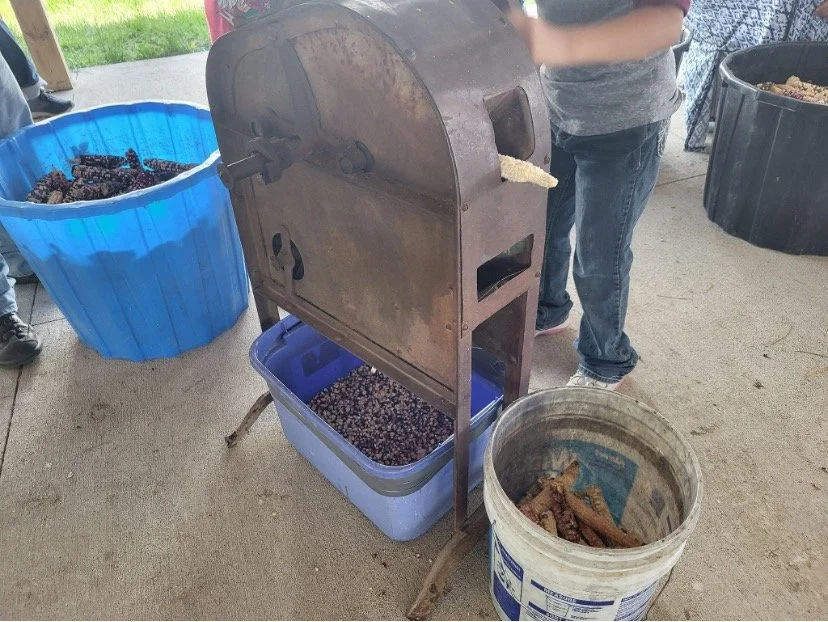
Under the shade of a pavilion in the summer of 2024, children’s joyful chattering mixed with the rhythmic rotations of an antique corn sheller and perpetual plunking of cascading kernels.
“Want to help me carry this basket?” Gerald offered a girl around age six.
She nodded enthusiastically.
“Is it too heavy?” Gerald asked.
“No!” the girl answered with confidence.
I watched from a nearby picnic table. This scene—an older man helping a child carry an overflowing bucket of multicolored corn cobs—appeared simple, mundane, yet it captured an unlikely alliance most in the current US political climate and agricultural community wouldn’t guess was happening in rural Nebraska. We were on land owned by the Ponca Tribe, of which this young girl was a member. Those cobs were Ponca sacred corn. And that man was a white, multigenerational farmer who had grown this corn on land his family had farmed for over 100 years but in 2018 was returned to the Ponca, whose ancestors had been removed from that land nearly 150 years before.
The story of what brought us all together under this pavilion began in the early 2010’s. A multinational company had proposed construction of an oil pipeline through several midwestern states. Despite most of their neighbors' signed agreements to this pipeline that would run through their properties, Gerald and Colleen Weber began attending meetings to organize those in opposition.The coalition that emerged allied two groups that were not commonly viewed as aligned: rural white ranchers and tribal communities. They took on this notion of an “unlikely alliance” publicly in their marketing and organizing actions, many of which the Webers hosted on their farm. During one such event, Gerald sat in a Teepee set up on his farm by Ponca organizers and listened to one of their leaders speak, recounting this memory to me years later:
“[The Ponca leader] talked about the Trail of Tears and how his grandfather was eight years old when he probably walked right through the area that I'm sitting in right now…Women braided their existing corn supply in their hair and in their clothing so they could take some, but they didn't get much. And he said, ‘I would like to see us rejuvenate that corn.’ And he asked me, ‘If we can find some of that corn, can we plant it here?’ And I said, ‘Absolutely.’ So that’s kind of where the idea began.”
For the next several years, coalition members gathered each spring on a corner of the Weber’s property to plant approximately 3 acres of sacred corn, and returned each fall to harvest it. This cooperative planting began to change the Weber’s thinking about the land these seeds grew from. “From the first time we planted the corn, [we] developed quite a relationship,” Gerald explained. “And over the years, Colleen and I did a lot of talking, and we said, ‘This is their land. We've let them plant the corn here, but in reality, they should be planting that corn on their land, not our land.’” In 2018 at that year’s planting, the Webers, Ponca tribal leadership, and their lawyers signed a deed transferring the three acres the sacred corn was planted on plus seven acres of primarily forested ground of the Weber’s property to the Ponca[1].
Fast forward to 2024, and I traveled with Gerald and Colleen several hours to the first planting of these sacred kernels at the Ponca powwow grounds. About 50 people gathered at picnic tables under the pavilion. Kyle, the event’s leader in his mid 30’s, began by greeting and thanking attendees including the tribe’s Language and Culture Committee for organizing the day. Three instructors taught everyone how to say the words for three entities central to the day in their native language: ground, corn, and water. A university ecologist, one of the few white attendees here besides Gerald, Colleen, Colleen’s cousins, and myself, gave a brief talk about the history of the sacred seeds and the traditional method we would be using to plant them. As he described the exact depth to drop the seeds into the soil— the length of a woman’s finger down to the second knuckle, or about two inches, he explained—I watched a young boy measuring this distance out on his own pointer finger.
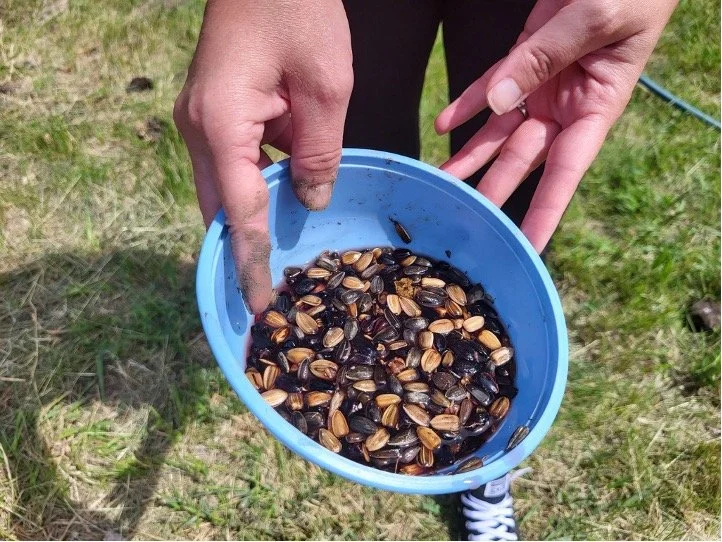
The speaker concluded by stating the day’s goal: “Returning the corn to its ancestral land. And from here, the corn will be home.” Kyle then instructed us to make our way to the side field for planting to begin. Folks took on specific tasks in each step preparing the ground for planting: soaking the seeds in water, running the garden tiller, building soil hills and seed beds, placing the seeds, and planting sunflowers around the perimeter for maximum pollination. Attendees of all ages took turns in the process, while others socialized and watched along the edges.
With Gerald and Colleen coming from a generational corn-growing farm family—“experts,” according to dominant white American agricultural ideology—I wondered how they navigated these spaces. “We’re just participants,” Gerald told me the night before, “We want to learn. You want something done a certain way? We want to do it that way.” In this statement, Gerald acknowledged that techniques varied between his own culture and within the tribe. Most crucially, though, this deference to Ponca techniques gestured toward a recognition of this day as a moment of reclamation against the delegitimizing violence the tribe had experienced around its agricultural knowledge.
“The native culture—there was such a long period of time where it was totally removed. Language and culture, both,” Gerald had explained to me the first day I arrived to his farm. “They lost the actual farming,” Colleen added. “And they haven't really got it back again.” These remarks verbalized the reality that the violence of settler colonialism was not only enacted via stolen land, genocide, and forced removal[2]: it also operated through the breaking up of families, native language continuity, agricultural knowledge, and connection to land as kin, harming indigenous peoples’ ability to grow food and robbing them of their food sovereignty[3].
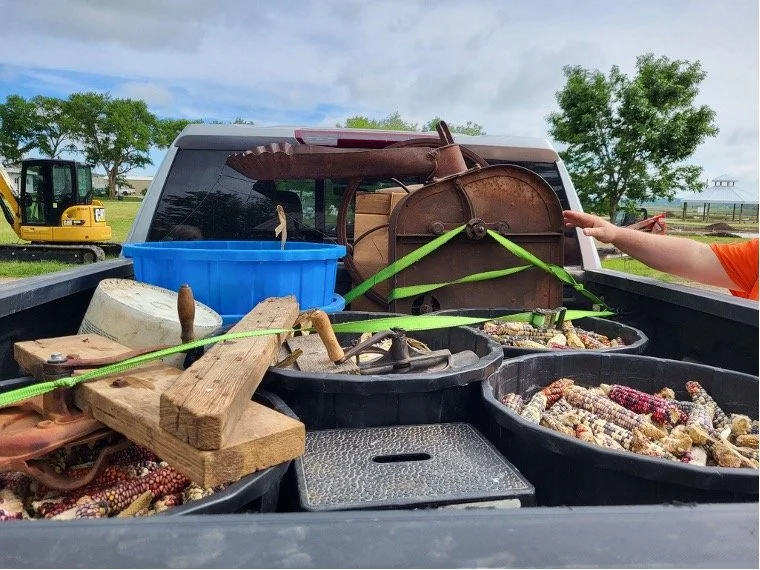
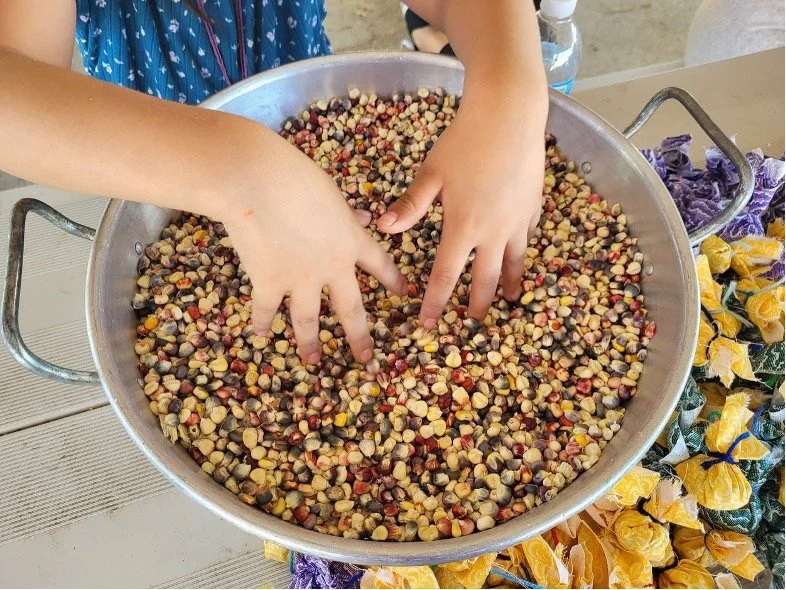
After several hours of planting, the afternoon continued with lunch, a drum circle and dance, and shelling and bundling the corn from last season’s harvest on the tribe’s transferred portion of land back next to Gerald’s farm. Several men helped Gerald unload four plastic buckets of husked cobs as well as a cast iron sheller from his truck bed. “I have not seen one of these since I was little at Thanksgiving time!” a man remarked. Observers commented in overwhelmed amazement at how much corn there was. Lucy, one of the Ponca elders in attendance, noted she had thought we would be shelling by hand. Gerald assured her that we could proceed whichever way she liked, to which Lucy answered with a chuckle that she much preferred the sheller, spurring laughter from the group.
Gerald, Colleen’s cousin, and a few other adults oversaw the shelling process, which—whether the intent or not—became crowded with children wanting to participate. The pavilion grew loud with the sound of kids’ excitement, corn kernels cascading into bins, and adults trying to balance teaching the children safe technique with letting them have ownership of this task. “Just keep your fingers far back!” someone shouted. Some kids preferred quick processing and celebrating being the first to empty their buckets, while others stood for minutes at the bins carefully selecting the coloring of the specific cob they’d put through the sheller next.
I sat next to Lucy at a picnic table as we both quietly watched this slightly chaotic, yet clearly endearing scene.
“Thank God for kids.” Lucy mused, breaking our silent observation. “This is something when they're older, they can tell their kids they did. You know, this is a memory that ain't nobody ever going to have again. These kids live in the city, so they're really getting something.”
“Have they been to the land where this is grown?” I asked.
“Just the one in the red,” she answered, gesturing to a boy around age ten in a red t-shirt.
We watch for a few more moments.
“So [my] Dad met these guys a long time ago. They're good people,” said Lucy.
“Who?” I asked, thinking she meant the families of the children.
“Gerald and his family,” she clarified. “And this is what you need—people that'll come and teach these guys, because this is what we've all lost. So it means a lot to us, you know. And like I said, that's where we've gotten our corn for years is from Gerald's family.”
“And now you're going to have it right here, too,” I said, bobbing my head toward the fresh mounds of earth covering the afternoon’s planted seeds.
“Right out here,” she repeated. “That'll be so cool. My dad's dream.”
Lucy’s statement pointed to the reality that the reason I’d first heard of Gerald’s family within the context of my research on “ex-conventional” farmers—the pipeline activism, his regenerative practices, or even their land transfer—had been perhaps a surface-level entry point to understanding the relationship that had formed between the Webers and the Ponca. The corn planting at Gerald’s farm had first served as a way of recognizing the violence of dispossession that had removed Ponca people and Ponca corn from this place, and enacting a form of remediation by returning both native community and seed to it[4]. This next iteration, bringing the corn to be planted at the Powwow grounds and teaching Ponca youth to plant and process it, brought in an element of knowledge reclamation and youth education in traditional agricultural practices akin to the language revitalization message shared that morning.
“When's the last time corn was grown here?” I asked.
“When my mom was a little. She's 75, so it's been some time. This was some of my dad's stuff that he wanted to do. Just didn't get the time to. So it means a lot.”
“Did he know Gerald?”
“Yeah. That's why it means a lot to me for this to be done.”
Our conversation was paused again by the noise of the children yelling over the sheller. “We’re running out of steam!” someone shouted, laughing. “You do your job, and then Gerald can help throw it in,” Colleen’s cousin delegated to a younger child. “You’re doing fantastic!” Gerald remarked.
Seeing this unfold before her eyes—and seeing a white multigenerational farmer in her community actively committing land, labor, resources, and care to this effort—held real significance and emotion for Lucy. The Webers’ involvement suggested an honest reflection on what reckoning with culpability for the ecological and social harms within this place’s history could mean: Gerald’s transition from conventional to regenerative practices could address some elements, a transfer of Land Back others, but neither were treated as an end or a complete repair. What this moment asked for was a teacher. I realized Gerald’s lifelong career as a public school educator may have been as key today as his secondary job as a grain farmer. It wasn’t his technical knowledge about corn planting or processing that this space needed or that he was giving to it; it was his time and labor the past several months to grow this corn, his gentle way of teaching the kids the generational skills he’d been given and they had not, and this antique machine he’d lugged in the back of his truck.
Lucy’s voice picked our conversation back up. “So yeah, it means a lot. More than most people would think, you know?”
While both her parents were now passed, they’d attended the first planting at Gerald’s farm. She felt they were part of this moment, too. “My dad always wanted to bring [the corn] back here to the people, always to the people. And he was all about the kids learning stuff. So just these little kids helping—he's just smiling down on us. He's happy as a clam.”
A child’s voice broke through our conversation, screaming “Where did it go?!” as a cob shot down the sheller.
“Very happy,” Lucy repeated, a reflective smile on her face.
[1] This form of Land Back can be analyzed through several decolonial scholarly lenses including Wittman and James’s agroecological approach (2022), Tuck and Yang’s consideration of incommensurability (2012), Lennon’s analytic of “improperty” (2025), and Nichols’s discussion of the “recursive logic of dispossession" (2018).
[2] See Harris 1993; Wolfe 2006; Tuck and Yang 2012; Nichols 2018
[3] See LaDuke 1999; Coté 2016; Burch 2016
[4] For examples of scholarship on reclamation of indigenous foodways through sacred seeds, see White 2019; Shiva 2016; and Wilson 2021
Works Cited
Burch, Susan. 2016. “Disorderly Pasts: Kinship, Diagnoses, and Remembering in American Indian-U.S. Histories.” Journal of Social History, Volume 50, Issue 2, pp 362–385.
Coté, C. (2016). “Indigenizing” Food Sovereignty. Revitalizing Indigenous Food Practices and Ecological Knowledges in Canada and the United States. Humanities, 5(3), 57.
Harris, Cheryl I. 1993. “Whiteness as Property.” Harvard Law Review 106 (8): 1707–91.
Lennon, Myles. 2025. “Improperty.” American Ethnologist 52: 7–18.
LaDuke, Winona. 1999. All Our Relations: Native Struggles for Land and Life. South End Press
Nichols, Rob. 2018. “Theft Is Property! The Recursive Logic of Dispossession.” Political Theory 2018, Vol. 46(1) 3 –28.
Schneider, Lindsey. 2022. “‘Land Back’ Beyond Repatriation: Restoring Indigenous Land Relationships.” The Routledge Companion to Gender and the American West, 452-464.
Shiva, Vandana (ed). 2016. Seed Sovereignty, Food Security: Women in the Vanguard of the Fight against GMOs and Corporate Agriculture. North Atlantic Books.
Tuck, Eve and K. Wayne Yang. 2012. “Decolonization is Not a Metaphor.” Decolonization: Indigeneity, Education & Society 1(1): 1-40.
White, Rowen. 2019. “Planting Sacred Seeds in a Modern World: Restoring Indigenous Seed Sovereignty.” In Indigenous Food Sovereignty in the United States: Restoring Cultural Knowledge, Protecting Environments, and Regaining Health. Devon Mihesuah and Elizabeth Hoover (eds). University of Oklahoma Press.
Wilson, Diane. 2021. The Seed Keeper. Milkweed Editions.
Wittman, H. and D. James. 2022. “Land governance for agroecology.” Elementa: Science of the Anthropocene 10: 1.
Wolfe, P. 2007. “Settler colonialism and the elimination of the native.” Journal of Genocide Research, 8(4), 387-409.